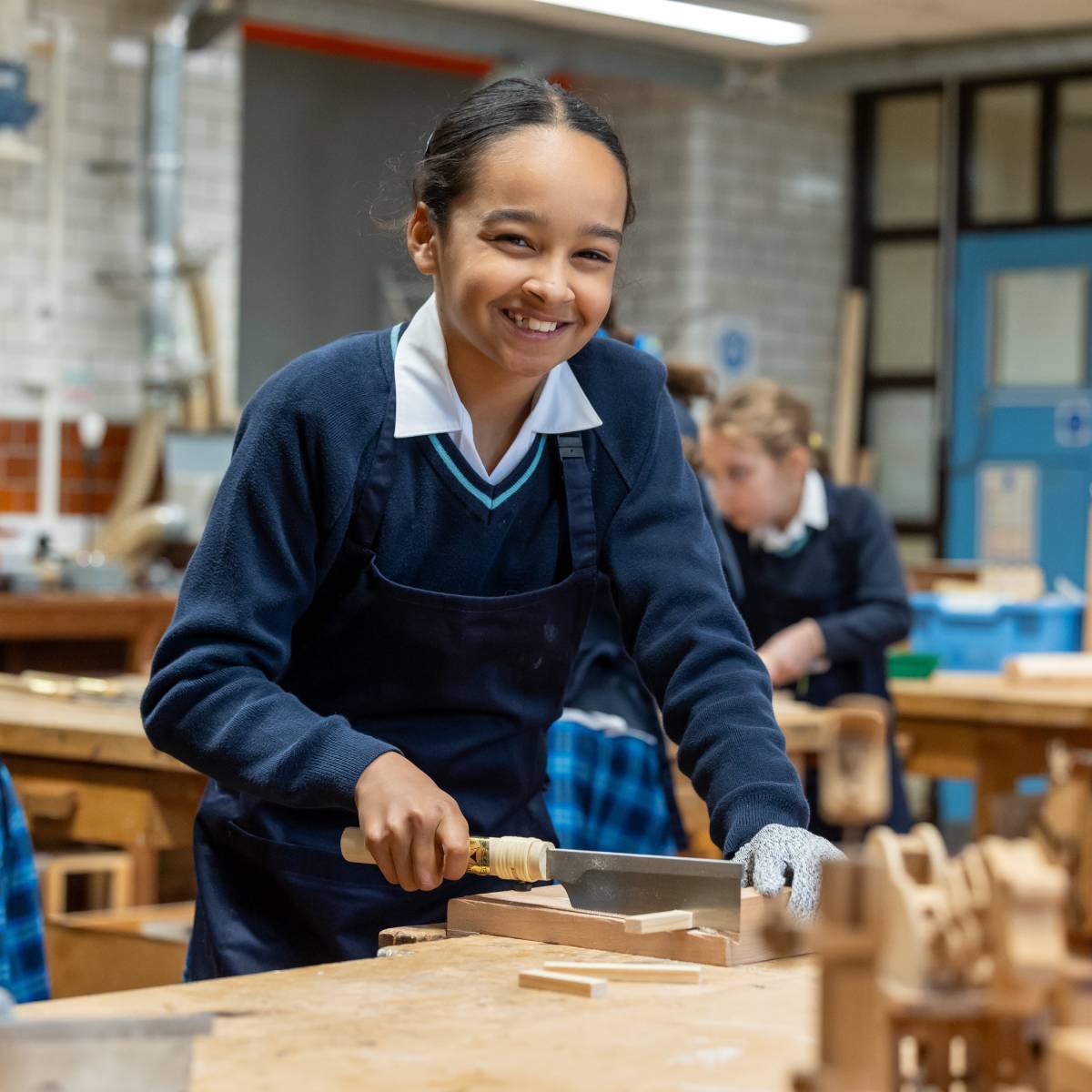

‘What do you want to be when you grow up?’
Royal High voices, Expert voices, Sixth Form

‘What do you want to be when you grow up?’
I am sure you remember being asked this question, and, if you’re anything like me, you didn’t have a ready answer, or, if you did, you may well have changed your mind several times since! Today’s students will have even more difficulty giving an answer, as technology and connected changes in the job market mean that we haven’t worked out what many of the things they could ‘be’ are.
These uncertainties will be foremost in the minds of our Year 9 students and their parents following our recent Academic Evening, as they begin to narrow down the subjects they would like to take at GCSE, a process that they will complete alongside our Year 11s, who are completing their A Level subjects and Electives choices.
This year, our students make their choices against the background of the government’s recent Curriculum and Assessment Review. The recommendations for 2027 implementation by maintained schools are wide-ranging: greater choice in STEM options, a greater focus on the Arts, promotion of oracy across the curriculum and a greater focus on skills for life. At Royal High, we welcome these findings as they confirm the value of what we have been doing for years!
The reason our curriculum works at Royal High is that it is focused on our values. We believe that Confidence, Curiosity and Connection are essential to building a future-focused, girl-centred curriculum. These are supported by our Royal High Learner Qualities – dispositions that we encourage in every lesson and activity our students undertake: we want our students to be Brave, Reflective, Inquisitive, Collaborative, Kind and Sparky, so that they can ‘be anything’ when they grow up.
Confidence is an essential value in girls’ education, as it is the key to unlocking potential. We work to ensure that we provide learning environments where girls feel empowered to speak up and take intellectual risks. Students are challenged to be brave. This does not mean loud or brash; rather, it means that we build our curriculum around opportunities for girls to put their ideas across in a supportive atmosphere where high levels of support allow us to demand high levels of challenge. Our students are encouraged to be sparky – fully engaged and ready to have fun with their learning. Oracy is a feature of our learning, from Poetry by Heart in Year 8 to debating competitions and mandatory mock interview practice for all Year 12s – come and meet our students, and you will see the difference that confidence brings.
Curiosity is central to our girl-centred curriculum. The pride of each prep school student is their discovery book – the place where they record the intellectual adventures that arise from such cross-curricular enquiries as ‘All the World’s a Stage’ where, using the fully cross-curricular Reggio Emilia approach, the girls are challenged to investigate every facet of Elizabethan life. This approach requires them to investigate social, economic and literary aspects; they develop their skills across traditional curriculum areas, driven to be inquisitive and reflective in their learning.
In the senior school, this approach is continued and amplified. Our computer science lessons do not only teach our students to code; they also demand critical engagement with the process of programming, measuring and correcting bias in outputs. The Festival of Ideas challenges students to create and present original projects based around fruitful themes, for example ‘progress’ or ‘buoyancy’. Students take an immersive approach to this collaborative work, producing stunning outcomes in concert with their peers from other GDST schools.
We build on these skills during the GCSE years, where curiosity is written into every curriculum opportunity. Students extend themselves through taking Classical Greek, Dance, Further Maths or Astronomy as additional GCSEs, and in the Sixth Form our electives programme allows students to develop future skills for university and beyond. The EPQ develops their scholarship through devising, presenting and producing an extended response to their own research question. Pure academia is balanced with creativity through the AFA Creative Writing Course or participation in the Leiths Cookery School Advanced Cookery Course, and financial acumen is developed through the Chartered Institute for Financial Securities and Investment Certificate. Indeed, curiosity is also demonstrated by our teachers, as they continue to sharpen and develop their pedagogy through action research to ensure that they engage with the latest evidence-based practice in their pedagogy.
Our curriculum also teaches students the value of being connected: with one another, with their peers in other GDST schools and with the wider world. Problem Based Learning, our unique and innovative timetabled subject focuses on collaboration to develop future-focused problem-solving skills. Students work in groups to solve real-world challenges, collaborating with partners including the University of Bath, Bath Preservation Trust and Lansdown Nature Reserve to design, test and present innovative solutions.
It is also worth mentioning that our staff take a similarly values-based approach to their pedagogy. Being connected with the GDST, we benefit from cutting-edge research to ensure that we can provide that high support–high challenge environment that enables our students to gain the confidence to thrive. The GDST Girls Futures Report, based on research evidence from over 1,000 pupils in all school settings, discovered that girls in a single-sex environment “are more comfortable speaking out and expressing their views; and significantly less likely to feel that being a girl holds them back from participating in subjects at school.” Our staff are curious subject specialists who are deeply concerned about the latest developments in teaching and learning – whether this is through taking the highly regarded TEMC course to engage multilingual learners or designing and leading INSET sessions to share good practice with their colleagues. We take our role as experts in girls’ education very seriously indeed.
“ ‘whatever I want to be’”
So, ‘what do you want to be when you grow up?’ We very much hope that for our students, ‘whatever I want to be’ is the answer – some will have a clearly articulated goal, some will have a multitude of ideas and some will have no idea – and that’s as it should be! Our curriculum, nonetheless, will give them all the tools they need to make a success of whatever they choose.
Hadrian Briggs, Deputy Head - Academic